What Adults Without a Doctor on Speed Dial Do for Health Advice
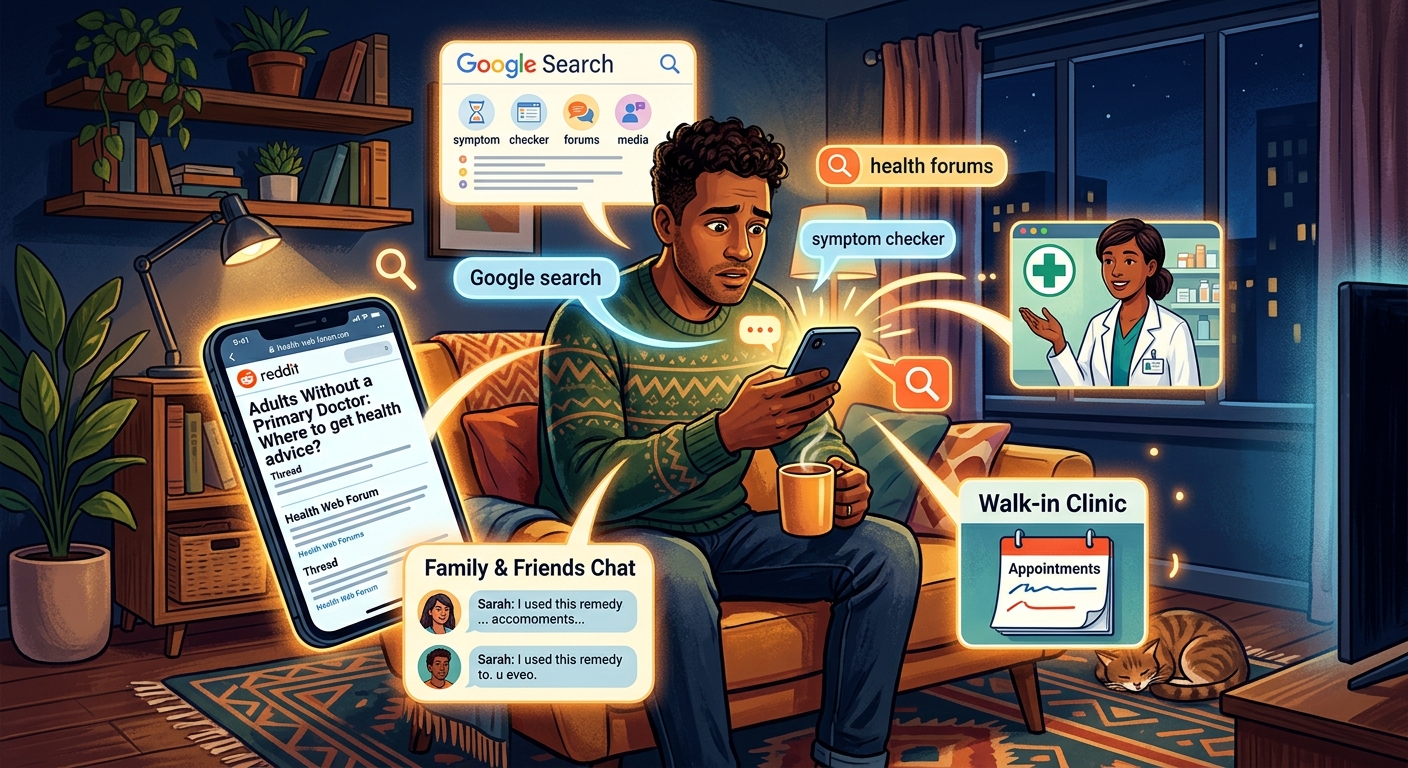
You notice something strange on a Saturday afternoon. A mole that looks different than it did last month. A heart rate that will not settle after you sit down. A prescription you cannot afford to refill for another two weeks. If you have a primary care physician you see regularly, you might leave a message and wait for a callback. But for a growing number of adults in this country, that call is simply not on the table. There is no doctor on speed dial. There is no employer plan with a nurse hotline buried in the benefits packet. There is just the phone in your hand, a symptom that will not go away, and a question that deserves some kind of answer.
The Rundown
- Millions of freelancers and gig workers lack employer-sponsored health coverage and have no regular doctor on call.
- When something feels off, the default first steps are symptom searches, Reddit threads, and texts to any medically trained contact they know.
- Conversational AI has become a common early filter, helping people understand symptoms, lab results, and medication questions before deciding on next steps.
The Coverage Gap That More Adults Are Living In
The image of the uninsured American as someone in crisis no longer captures the full picture. According to health insurance coverage data from the U.S. Census Bureau, millions of working-age adults go without coverage each year, and many of them are not unemployed. They are freelancers, independent contractors, gig drivers, part-time employees, and remote consultants who built careers entirely outside the traditional employer model.
For many of them, the math on individual health insurance plans is punishing. Monthly premiums for a single adult can run several hundred dollars, and that is before deductibles that stretch into the thousands. The result is a large group of capable, working adults who are making health judgment calls without a medical professional in their corner.
That does not mean they are reckless. It means they have gotten resourceful.
The 2 AM Symptom Search and What People Actually Find
The symptom search is almost always the first move. You type in what you are experiencing, and within seconds you are reading about fourteen possible explanations, two of which are alarming and twelve of which are probably irrelevant to your specific situation. The experience is maddening. It is also, in a rough way, useful as a first filter.
People who do this regularly develop a kind of triage instinct. They learn which sources are worth reading and which ones exist primarily to drive anxiety and ad impressions. Government health portals, academic medical centers, and sites that publish medically reviewed content tend to give cleaner, more grounded explanations than the content farms that optimize for catastrophizing.
The real problem is not the information itself. The problem is that most people are not trained to contextualize what they read. A symptom that sounds serious in an article might be completely benign in a specific person’s situation. A symptom that reads as trivial might actually warrant a call. That space between reading something and knowing what to do with it is where most of the trouble lives.
The Text to the Friend Who Went to Med School
Nearly everyone has one of these people. The cousin who is a nurse. The college roommate who did a residency. The neighbor who spent a decade as a physical therapist before switching fields. These contacts become informal anchors for health questions in a way that feels completely natural, because honestly, it is.
A quick message, a photo of a rash, a description of a pattern that keeps repeating, and you often get back something genuinely useful. Not a diagnosis, because they know better than to do that over text, but a calibration. Something like: “That sounds like it could be a contact allergy. Keep an eye on it. If it spreads or you get a fever, go in.” That kind of human context check is worth a lot.
The limitation is obvious. You can only text that person so many times before guilt starts to accumulate. Medical professionals have their own patients and their own lives. Most are generous with their time, until the demands become too frequent. People tend to hold those contacts back for moments when they truly do not know what to do, which means the bar for reaching out stays high.
Reddit’s Medical Communities and Why People Trust Strangers Online
It sounds counterintuitive, but communities like r/AskDocs on Reddit have become legitimately useful for people without easy access to professional guidance. The subreddit is moderated, requires users to share age, sex, and relevant history before asking questions, and often has verified medical professionals contributing to threads.
What draws people there is the specificity. You can describe your exact situation, share lab values, upload a photo, and receive responses from people who have seen similar presentations. The collective, when it is functioning well, can be remarkably good at filtering out worst-case spiraling and pointing someone toward a reasonable next step.
There are real limitations worth factoring in:
- Anonymity means you cannot verify credentials, even when someone claims to have them.
- Crowd agreement is not the same as clinical consensus, and uncommon conditions tend to be underrepresented in the threads.
- Comment threads go stale fast, especially for medication dosing questions or conditions with evolving treatment guidelines.
- People often unconsciously gravitate toward responses that confirm what they were already hoping to hear.
None of that has stopped people from returning. The combination of specificity, genuine community engagement, and zero cost is hard to replicate anywhere else at three in the morning.
Using AI as a First-Pass Health Filter
The behavior that has shifted most visibly in recent years is the move toward conversational AI for health questions. Not to replace a physician. Not to receive a clinical diagnosis. But to get oriented before deciding what step comes next.
The appeal is straightforward. You can describe your situation in plain language, the way you would explain it to a person sitting across from you, and get back an explanation written for a general audience. What does an elevated CRP level mean in the context of routine bloodwork? What are the common interactions between two medications you were just prescribed? Is it normal to feel lightheaded after starting a new blood pressure medication?
These are the kinds of questions that feel too minor to book an appointment around, but too specific for a keyword search to answer cleanly. When you ask AI in plain conversational language, you typically get a coherent breakdown in seconds. That helps you figure out whether you are in a “wait and see” situation, a “call the nurse line tomorrow” situation, or something that actually needs to be looked at in person.
People who use these tools regularly have learned to treat the response as a starting point, not a conclusion. AI can explain what a clinical term means, flag that a combination of symptoms sounds worth following up on, and help you prepare clear questions for a real clinician. It is not the clinician. As a low-friction orientation step for someone trying to calibrate their concern level, though, it has earned a steady place in the process.
Reading Your Own Lab Results Without a Decoder
One use case that comes up repeatedly: lab results. More people are ordering direct-to-consumer panels now, or getting bloodwork through telehealth services, and the results arrive as a PDF full of abbreviations and reference ranges. Some values are flagged. Many are not. The explanation provided is often minimal at best.
Conversational AI handles this kind of question particularly well. You can describe a lab value, add context about your age and general health history, and get a plain-language explanation of what the number represents and why it might fall outside the expected range. A slightly elevated TSH. A low ferritin reading. A borderline A1c. These are numbers a person can understand without a medical degree, given a patient and clear explanation.
People do this because the alternative, waiting weeks for a follow-up appointment just to hear that something is “slightly elevated but nothing to worry about,” feels like a genuine waste of everyone’s time. Getting a preliminary orientation lets you arrive at that appointment with sharper questions and a calmer head.
Making Smarter Calls Without a Doctor in Your Corner
Every tool described here, from symptom searches to Reddit threads to AI assistants, works best as a filter rather than a final answer. These resources are good at helping you calibrate. They are not good at replacing the physical exam, the full patient history, or the clinical judgment that comes from years of training.
Adults who rely on these tools regularly tend to develop an internal sense of when the research needs to stop and the booking needs to start. If the symptom is getting worse rather than better. If it is affecting sleep or daily function. If multiple independent sources are pointing toward the same concern. If something feels wrong in a way that is hard to articulate. Those are the moments when you close the browser tab and pick up the phone.
The goal was never to avoid the healthcare system entirely. The goal is to use limited time and money wisely, and not spend a substantial out-of-pocket cost on something that turns out to be dehydration or seasonal allergies. For millions of adults running exactly that calculation every day, having a range of first-pass tools available is not a workaround for a broken system. It is just how adult life actually works now.
You become a better reader of your own body over time. You get clearer at describing what you are experiencing. You develop a sharper sense of what is noise and what is signal worth taking seriously. The tools have gotten genuinely better at supporting that process. What has not changed is the underlying gap between feeling something and being able to access the system that exists to help with it. People are filling that gap with whatever they have, and they are getting surprisingly good at it.