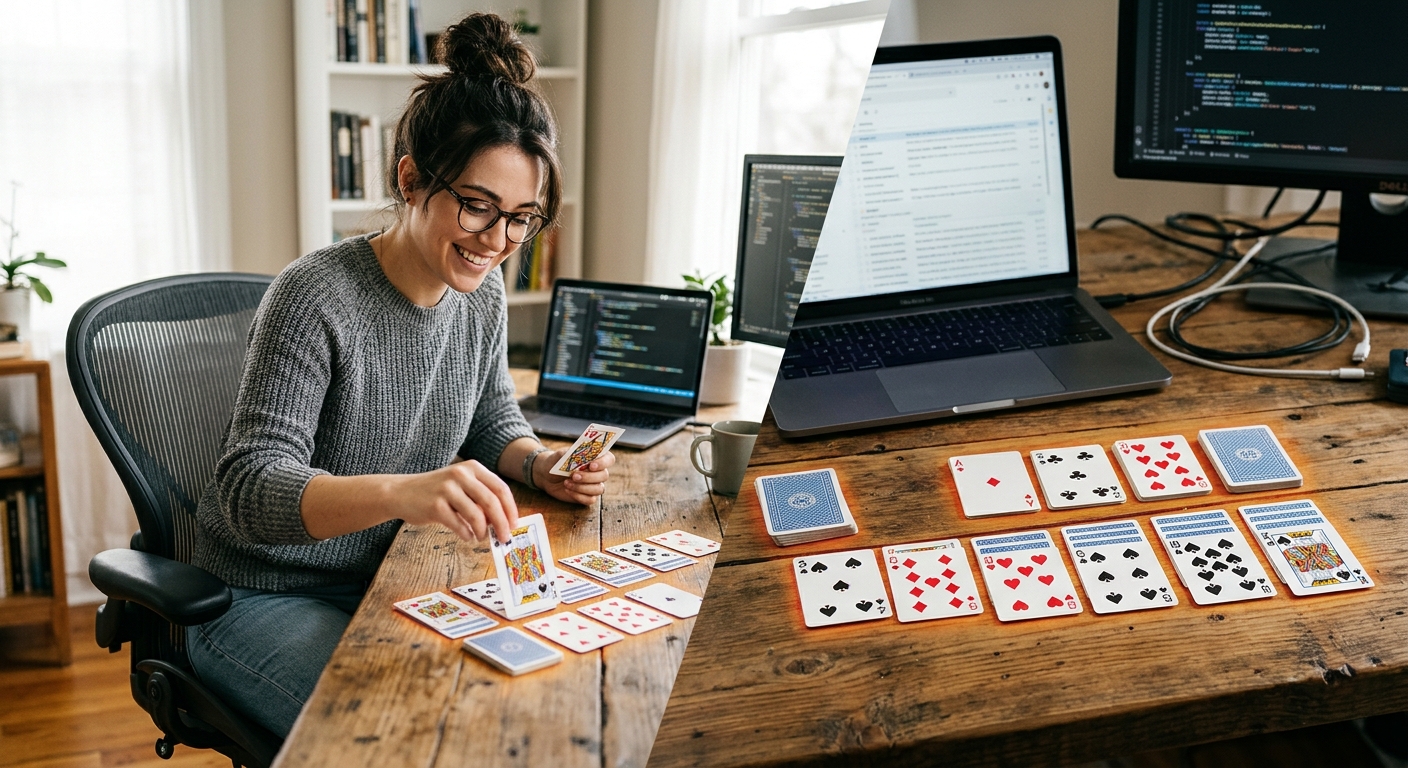
Why Solitaire Fits the Science of Taking Better Breaks From Work
You have read the same sentence four times. Your coffee has gone cold. A message arrives, and even deciding whether to answer feels tiring. At moments like these, a few minutes of solitaire can feel surprisingly inviting. The cards offer a small, clear task after an hour of messy ones. Nobody needs a reply. Nothing requires a meeting. There is simply a move to consider.
A Better Break at a Glance
- Short breaks can ease fatigue without guaranteeing better performance.
- Solitaire offers a change of focus, though it still requires attention.
- A manageable challenge can feel pleasant without needing a win.
- A clear stopping point helps keep play within your available time.
- Screen-based play belongs alongside movement and time away from devices.
Short Breaks Can Help Without Becoming Another Productivity Task
Work often asks you to hold several unfinished things in mind. You might be writing a proposal while remembering a deadline and anticipating feedback. Even during a quiet stretch, those demands can make it difficult to feel mentally off duty.
A break creates a pause in those demands. It does not have to produce a brilliant idea or make the next hour your best hour. Feeling less worn down is a useful outcome in itself.
A 2022 review of 22 independent study samples found that short breaks produced small improvements in vigor and fatigue. The overall effect on performance was not statistically significant. That distinction in microbreak research gives us a sensible starting point: brief pauses can support how people feel, but better output is not assured.
This research does not establish solitaire as a proven recovery method. It supports the broader value of short breaks. Solitaire fits that conversation because it offers one possible way to spend a pause, provided the game feels enjoyable and remains easy to leave.
A Small Card Game Changes What Your Attention Is Doing
Solitaire has an appealing boundary. The cards are visible. The rules stay fairly stable. You can usually understand the immediate goal without interpreting someone else’s tone or guessing what a manager meant.
That can feel refreshing after work built around ambiguity. A difficult email may have several possible meanings. A card either fits a sequence or it does not. There are still decisions, but their consequences stay inside the game.
For someone familiar with the rules, the pattern of scanning, moving, and revealing cards may feel comfortably absorbing. It gives attention somewhere else to settle. You are no longer rehearsing the same paragraph or waiting for a notification.
Yet a change of focus is not the same as an absence of effort. Solitaire uses visual attention, planning, and memory. A demanding deal can become another puzzle to wrestle with. Its usefulness depends partly on what you have just been doing and how much effort you want to spend.
Screen-Based Downtime Fits the Shape of Modern Work
Part of solitaire’s appeal is practical. A game can sit a few clicks away from the document you have been editing. You do not need equipment, a partner, or much preparation. During a small gap between calls, that convenience matters.
It also offers privacy. After a morning of conversation, a solitary activity may feel welcome. You can make choices without explaining them. You can pause without leaving someone waiting for their turn.
Some people find this kind of contained activity easier to leave than a feed that keeps presenting fresh material. A deal has a recognizable shape, even when you stop before it ends. That does not make every digital card game calm. Ads, streaks, timers, and rankings can all add pressure.
The useful question is how a particular game feels in your hands. Does it offer a pleasant change of pace? Or does it introduce another score you feel obliged to improve? The same activity can serve different purposes on different days.
Difficulty and Uncertainty Shape the Experience
A game needs enough uncertainty to hold your interest. If every move were obvious and every deal ended the same way, solitaire might feel mechanical. Hidden cards and limited options give each session a little tension.
Looking at solitaire win rates helps explain why expectations need context. Variants, rules, available information, and player decisions affect the chance of finishing successfully. A percentage from one setup should not become a personal target for every session.
For a work break, the more useful issue is how that uncertainty lands. A manageable challenge may hold your attention without feeling heavy. A stubborn layout may leave you irritated. If losing makes you start another deal immediately, the game can stretch beyond the pause you intended.
Winning does not prove that a break restored you. You might finish successfully while feeling tense and rushed. You might abandon an unfinished deal feeling pleasantly detached from work. The outcome of the cards and the outcome of the break are separate things.
Give yourself permission to stop midgame. A break does not need a victory screen to count.
Different Kinds of Tiredness Call for Different Pauses
Before opening a game, notice what feels tired. Boredom, social overload, sore shoulders, and difficulty thinking can arrive together, but they are not interchangeable. A card game may suit one feeling while leaving another untouched.
If you have spent an hour handling emotionally demanding messages, a quiet game may sound appealing. If you have spent that hour inspecting tiny spreadsheet cells, more visual searching may feel less welcome. Your preference is useful information.
Matching the Break to What You Need
| How You Feel | How Solitaire May Fit | Another Useful Option |
|---|---|---|
| Bored with repetitive work | A familiar game offers a different small challenge. | Walk somewhere with a change of scenery. |
| Tired of conversation | Solo play removes the need to respond to anyone. | Spend a few minutes sitting quietly. |
| Physically stiff from sitting | Seated play offers little change in posture. | Stand, stretch, or take a short walk. |
| Frustrated by difficult decisions | An easier setting may suit you, but another puzzle may not. | Choose a pause without a goal to complete. |
These are starting points for personal judgment, rather than promises about how an activity will affect you. You may love cards after a demanding morning and prefer silence after lunch. There is no need to force a favorite pastime into every break.
A Clear Stopping Point Keeps Play Comfortable
The easiest time to decide when to stop is before the cards appear. Pick a small window that fits your day. Five minutes might be convenient, but it is a personal boundary rather than a scientifically established dose of solitaire.
Before leaving your work, write down the next small action. “Check the last paragraph” is easier to return to than “finish report.” That note gives you somewhere concrete to begin when the pause ends.
A few simple habits can make the session easier to manage:
- Choose familiar rules if learning a new variant feels like effort.
- Set a gentle reminder before starting.
- Turn off optional competitive features if they create pressure.
- Leave the deal unfinished when your available time ends.
Afterward, notice whether you feel less caught up in work. There is no need to grade the break. If the game leaves you impatient or reluctant to return, try a different activity next time. That is useful feedback, not a failure to relax correctly.
Your Body Still Needs Time Away From the Screen
A mental change of pace can happen while your posture barely changes. Your hand may still hold the mouse. Your eyes may still focus at the same distance. Those details limit what a digital game can offer during a deskbound day.
Official screen break guidance recommends that breaks or changes of activity allow people to move around, or at least stretch and change posture. A card session can be part of your downtime, but it should leave room for those physical changes.
You might stand and get water before playing. At the next pause, you might leave the device behind entirely. Alternating activities gives you more ways to respond to what you need, without turning every break into an elaborate routine.
Let the Cards End Before the Pause Does
Solitaire fits better breaks when it offers a modest, enjoyable change in attention. Its familiar rules can feel reassuring. Its uncertainty can keep a few minutes interesting. Neither feature guarantees recovery, and neither requires you to chase a win.
The most useful habit is being able to leave. Close the game while there are still cards on the board. Move your shoulders. Look away from the device. Return to the small next step you left yourself. A good pause can be ordinary, unfinished, and still give you something you needed.